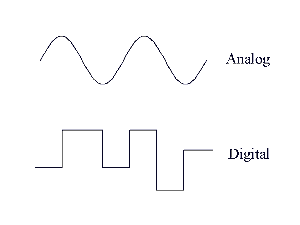

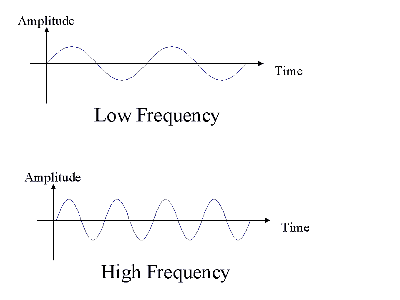
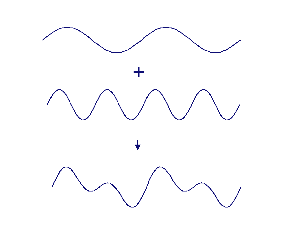
So now we send our voltage signals down the line, and in a perfect world with no lost of power, the other side will get the EXACTLY the voltage values we send. Unfortunately, this is not a perfect world, and ALL lines loses power. To decide on what happens to a signal when some power is lost in the line, we need Fourier Analysis.
Remember from above that we said a digital signal such as Fig 2-1(a) can be approximated by a complex analog wave made up of component sine waves of different frequencies. Each of those components will have a different strengths. Say we give all the components an index number 1, 2, 3, ... The component numbers which are low means the component wave have low frequencies, and components with high indices have high frequencies. On the right in Fig 2-1(a) is a graph of this. Each component wave (the index called "harmonic number") is has a strength. Some are high, like the 2nd harmonic. Some are low, like the 8th harmonic.
Why do we need to know what components waves make up the original signal we send? Because when a signal loses power, the high frequency components, with high index numbers, gets cut off (or attenuated). So for us to determine if a line can transmit in high enough frequency, we need to look at our original signal composed ONLY of it lowest frequency components. For example, if the line can only transmit in the one lowest frequency, we will have the signal in Fig 2-1 (b). This is hardly good enough, since the signal values (ie. amplitude) is about the same throught-out. We can hardly tell where the 0's are and where the 1's are.
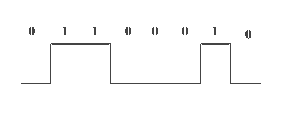
On the other hand, if the line can support the frequency up to the 8th harmonic component, our receiver will get the signal as shown in Fig 2.1(e). This is good enough, since at time 0, the amplitude is about 0, at time 0.1 sec (remember we are using 0.1 sec as our interval in this example) the amplitude is almost 1, at time 0,2 sec the amplitude is almost 1, and so on. We can approximately get back the original signal of 01100010.
So if we happen to have a line that can transmit up to the 8th harmonic component, we can send the 01100010. If the line can't, then we can simplify the wave form by sending less number of bits in the same amount of time.
Eg. Transmitting only the the four bits in the same amount of time
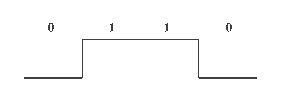
means a simpler wave form, and so don't need as much high frequency components to represent compared to the original
Nyquist have worked out based on a line's bandwidth (how high the frequency it can transmit) and the number of different digital values we can have, exactly what the maximum data transfer rate of the line is. Shannon have also worked out the same, but considering the ratio of noise to signal of the line as well. Their results and formulae are presented in the book Sec 2.1.3. In this unit, you are not required to know the formulae or how to use them, just keep in mind these formulae exists. Those motivated who wants to understand the theorems can read the text and approach me for further elaborations.