
|
|
|
|
|
|
|
DUE DATE: 5pm Friday 2nd June 2000 (please note the change of submission date from the original date of 26th May 2000).
This assignment is worth 25% of your final mark in this unit. As stated in the unit outline, YOU MUST SUBMIT this assignment to pass the unit.
Contents of this document:
Project Description
What you need to submit
Recommendations of what to do
The purpose of this project is to design a new local area network (LAN). You are the network administrators of a company (give your own name for the company). Your company’s primary business is providing Internet solutions to clients. Your company is expanding its Multimedia Design department, which is responsible for multimedia design and implementation for Internet use. To accommodate this expansion, a floor in the company’s main office with an existing network is to be upgraded to fit the current and expected future growth of the department. You job is to recommend the design and expenditures for the new network to cater for the department’s requirements for the next three years.
Current staff: 10 multimedia designers and programmers, 5 research and development staff, 2 system and network administrators, 1 accountant, 1 secretary, and 1 manager.
Expected staff growth: The number of designers and programmers are expected to grow by 5 every year for the next three years. Research staff is expected to grow by 1 every year for the next 3 years. The remaining staff levels are expected to remain the same.
General staff requirements: All staff needs to have a workstation of their own.
Specific staff requirements:
Designers and programmers: The designers and programmers require high performance workstations for their graphics work. They need very fast connections to the other workstations (at least 100Mbps locally) and to the Internet, to transfer large volumes of multimedia video and voice data.
Research staff: The research staff deals with research and developments into new technologies to be offered to clients. They require very high performance workstations to do their experiments and trials, as well as large working areas on the file server. Their work needs to be secured from unauthorized access. In addition to workstations, they also need a server to do computationally-expensive background processes. They also need a demonstration area in the building where they can do multimedia demonstrations to potential clients.
System administrators: The system administrators require quick access to all parts of network in the department, as well as quick access to the Internet.
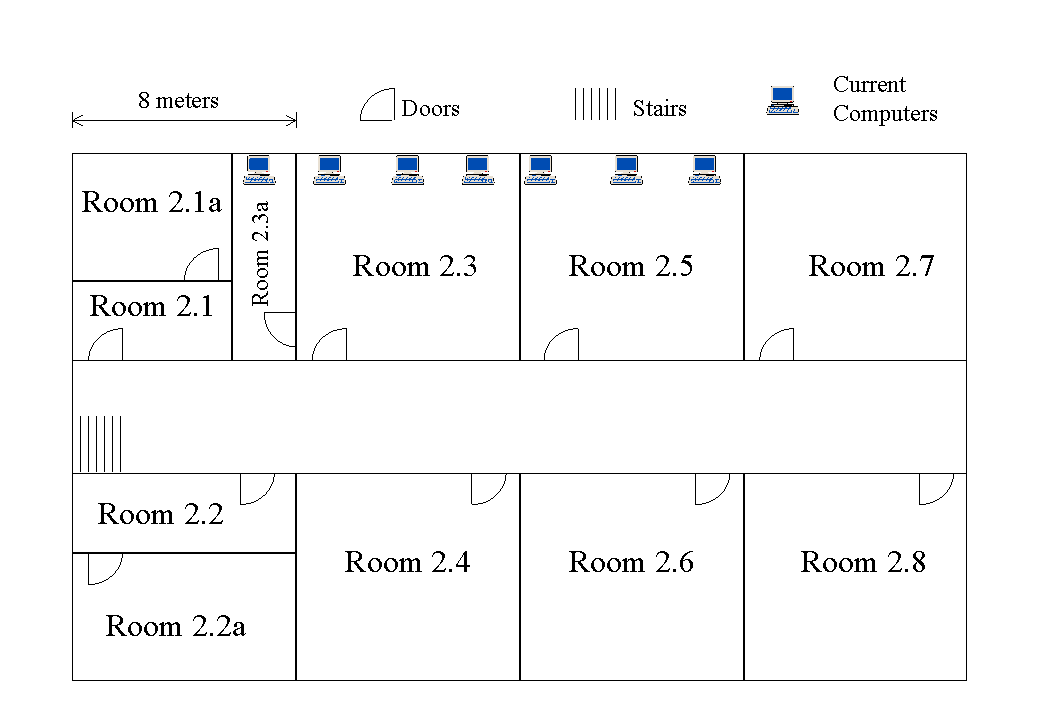
Each staff member needs be allocated an individual working area of at least 2.5x2.5 meter2, in addition to any group working areas you may wish to include.
Cables can be run under the floor.
Logical layout of the current network:
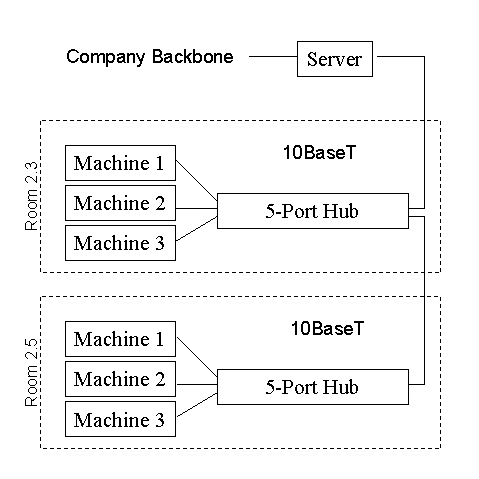
Currently rooms 2.3 and 2.4 each have a 10BaseT network with 3 machines in each. The current server is a very low-end machine which only does file serving and run basic Internet services. It resides in the room 2.3a.
The workstations and server can be sold at an expected price of $750 each if you choose to.
The building has a 100BaseFX Ethernet main backbone, which can be connected to from room 2.3a. The connection point for the backbone is next to where the current server is.
Servers:
Basic server: $5,000
High performance server: $12,000
Workstations:
Basic workstation: $2,500
High performance multimedia workstation: $5,000
Hubs:
10Mbps 5-port Ethernet for UTP: $80
10Mbps 8-port Ethernet for UTP: $100
10/Mbps 16-port Ethernet for UTP: $250
10/100Mbps 5-port Switch Ethernet for UTP: $250
10/100Mbps 8-port Switch Ethernet for UTP: $400
10/100Mbps 16-port Switch Ethernet for UTP: $900
10/100Mbps 24-port Switch Ethernet for UTP: $1300
10/100Mbps 16-port Switch Ethernet (14xUTP and 2xFiber Optics): $1300
Network Interface Cards (NICs) or adapters:
Ethernet 10Base2 or 10Base5 Coax Transceiver: $50
Ethernet 10BaseT Card for UTP: $50
Ethernet 10/100BaseT Card for UTP: $70
Ethernet 10/100BaseF Card for Fiber Optics: $550
Token Ring Adapter (or Interface) for UTP: $400
Token Ring Adapter (or Interface) for Fiber Optics: $700
Cables:
Ethernet UTP (10BaseT or 100BaseT) Category 5 Cables: $1 per meter (with connector on both ends)
Ethernet Coax (10Base2) Cables: $3 per meter (with connector on both ends)
Ethernet Coax (10Base2) T-connectors and Terminators: $5 each
* To hook up a 10Base2 coax cable to a Ethernet card, you need a T-connector. Both ends of a Ethernet Coax network should also have a terminator.
Multimode Fiber Optic Cable: $15 per meter (with connector on both ends)
Bridges and routers: $3,000 each (assume all bridges and routers are the same price)
Token Ring Wire Center, usually called Multistation Access Units (MAUs) or Controlled Access Units (CAUs): $3,000 each
Professional installation of power sockets and cabling: $1000 per room + $50 for each network point (not including cost of equipment). If a room already has network support, and the cabling do not need to be replaced, the cost is only the $50 for each new networking point.
Maintenance and networking costs per server: $1000 per year.
Miscellaneous networking costs per workstation: $100 per year.
Note: Some of these prices are overall estimates, and the components are not the only choices available. Real world decisions are a lot more complicated that what the list above suggests. For some of the components, the choices and actual market prices could vary quite significantly depending on the type and the vendor you choose. For the sake of this project, you are NOT required to get actual current market prices unless you decide to include components not in the above list (you can refer to http://www.data.com/Directory/index.html for very extensive price listings in US$). Also, I have included many items you may conceivably need – it doesn’t mean you have to include most of them in your design. As a matter of fact, some of the choices are neither necessary nor desirable. Always remember the design motto KISS (Keep It Simple, Stupid).
$250,000 over 3 years. You should try and keep under budget as much as possible – you do not have to use every cent in your expenditure.
Your project group is required to submit the following, to be assessed as a group mark.
The diagrams must show
Use separate diagrams if necessary. If you choose to hand-draw the diagrams, make sure they are neat.
If there are various alternatives with no significant difference between them, then you only need state the alternatives, and say that no significant differences exists in the choices.
The project management summary should include:
Each group member is also required to submit a report on one of the following areas (of your own choosing), to be assessed as an individual mark.
This individual report of no more than 4 pages must include:
Members of the same group may choose the same area, but you may find having knowledge on different areas would enhance your decisions made in the group component. Parts of this individual report can appear as a summary items in the group deliverables, if you believe it will enhance the group submission.
The following is a list of items you should consider in your design and budgeting.
Keep in mind the following issues
Some important items you do NOT have to consider for this project:
I recommend you start by deciding on the best network and subnetwork types for the different staff requirements. Review sections 4.3.1, 4.3.3, 4.3.4, 4.4 and 4.5 of the textbook and the corresponding lecture notes. The popular choices these days are Thinnet for connecting a few machines, and Fast Ethernet for larger networks. Thinknet and Token Rings are also possible candidates. Token Bus is only used in conveyor belt like factory settings, and FDDI are usually for connecting larger WAN over a few hundred kms. Once you decide on the network type(s), you basically have decided on the topology and cable types as well.
The next thing to do is to decide on what workstations and server(s) to get, how many, and where will be located. Having those, you would essentially have most of the network. Then you can work out any remaining little details. There are a lot of decisions you will have to make which may require information not stated here (eg. do the manager want to have the secretary and clerks close by). In situations which are not explicitly stated, you may assume anything reasonable.
Do not try and construct a complicated network for the sake of making your submission interesting. The best networks are the ones which are simple. Do not waste time on insignificant decisions, like whether a machines should face the door or away from the door. These decisions are insignificant with respect to network design.
For the individual component, you can refer to the textbook Practical Networking by Frank Derfler Jr (QUE, 2000), available in the Murdoch Library closed reserved. It contains chapters on each of the components listed above. It also contains other material you may find helpful in the group component.
H.L Hiew
Unit Coordinator
|
|
|
|
|
|
|
Document author: H.L. Hiew,
Unit Coordinator
Disclaimer &
Copyright Notice © 2000
Murdoch University


